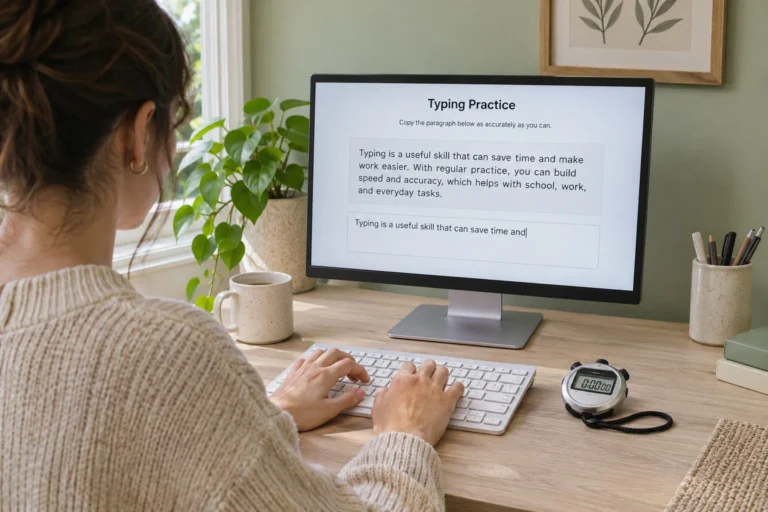
How Can You Improve Your Typing Accuracy?
To improve typing accuracy, first identify the mistakes you repeat.
Slow down enough to type a short passage carefully, practice the troublesome pattern, and check whether those errors become less frequent. Accuracy improves through specific feedback, not simply more attempts.
Learn What Your Accuracy Score Counts
Typing tools can measure errors differently. On Typing Scale, entry accuracy tracks correct character entries out of all character entries.
If you enter a wrong character and later fix it, the first mistake still counts in that measure.
Uncorrected errors describe mistakes left in the final text. These are useful labels to read together: a clean final passage does not mean you made no mistakes while producing it.
The typing accuracy test explains the scoring beside the tool.
Find Your Repeated Error Pattern
After a short attempt, choose one recurring problem. You might press a neighboring key, skip a space, reverse a letter pair, or miss a capital.
Do not treat every error as the same problem.
| Error pattern | A focused next step |
|---|---|
| A neighboring key replaces the right letter | Locate the correct key, then alternate it with a familiar key slowly. |
| Two letters appear in the wrong order | Type the pair inside several short, different words. |
| Spaces or punctuation are missing | Read a complete phrase before typing it, including its final mark. |
| Capitals interrupt your rhythm | Practice the Shift combination on its own, then in a sentence. |
Use a Small Accuracy Drill
- Choose a short sentence that includes the pattern you want to practice.
- Type it at a pace where you can notice each mistake.
- Correct the text, then repeat the pattern in a different sentence.
- Finish with a fresh paragraph to check whether the improvement carries over.
For example, if you often reverse th, try an original line such as: The thin thread lay beside the thick cloth. Accuracy is the first task here.
Add speed only when the pattern feels more controlled.
You can put your own non-sensitive practice sentence into the custom typing test. For longer text without a countdown, choose paragraph practice instead.
Avoid pasting private messages or documents into any practice activity.
Decide How to Handle Corrections
Use Backspace when the exercise allows it, but notice why you needed it. Repeatedly fixing the same word is a sign to practice that word or letter pair more slowly.
A corrected passage is useful, even when the original error remains in your entry-accuracy score.
If you are preparing for an employer or school assessment, read its rules separately. It may use a different accuracy formula or correction policy.
A practice score does not establish that you met another provider’s requirement.
Make a Useful Comparison
Keep the same duration, difficulty, and input method when comparing accuracy. Start with a manageable passage, then add harder punctuation or vocabulary only after the current level feels comfortable.
Your next goal can be fewer repeated errors in a similar amount of text. You do not need to assign yourself a universal pass mark.
When that pattern becomes steadier, use the typing speed routine to build pace while continuing to watch accuracy.
Common Questions
Does fixing a typo restore 100% accuracy?
Not in Typing Scale’s entry-accuracy measure. Correcting the text removes an uncorrected error, but the original incorrect entry still counts. Other assessment providers may use different rules.
Should I slow down to improve accuracy?
Try a pace where you can recognize and avoid the repeated mistake. Practice the pattern in fresh sentences, then increase your pace gradually while checking whether errors return.