How Can You Improve Your Typing Speed?
To improve typing speed, work on the mistakes and pauses that interrupt your rhythm.
Start with a repeatable test, practice one weak point, and check your progress using the same settings. A faster score is useful when your accuracy stays steady.
Start With a Repeatable Baseline
Take a one-minute typing test using text you have not memorized. Choose a difficulty that you can read comfortably, and let yourself type normally rather than chasing a personal record.
Write down your words per minute (WPM), accuracy, and the setting you used. WPM is a typing rate, while accuracy describes how often your entries matched the passage.
Keep both numbers because a rushed attempt can raise one and lower the other.
- Use the same keyboard or phone for comparisons.
- Keep the duration and text difficulty unchanged.
- Record a normal attempt, not just your best score.
Find What Slows You Down
Look at the moments when you stop, look down, or correct several characters. The problem might be one letter pair, an unfamiliar word, or switching between capitals and punctuation.
Practice that pattern rather than repeatedly taking a full test.
| What you notice | What to practice |
|---|---|
| You search for individual keys | Learn a small group of key positions before adding more. |
| You reverse letters in familiar words | Type the word slowly, then place it in a new sentence. |
| You stumble over capitals or symbols | Practice the exact Shift-and-key combination at a comfortable pace. |
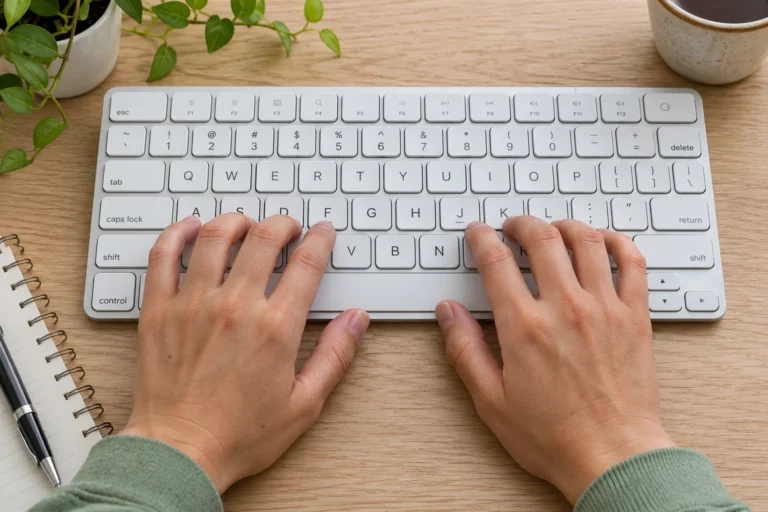
If you are learning finger placement, use the home-row key guide as a starting point.
Home row is a reference position, not a rule that every experienced typist must use the same way.
Try a Short, Focused Routine
The eight-minute routine below is a practical starting example, not a proven ideal schedule.
Shorten it if you feel tired, and spend more of the session on the pattern that needs attention.
| Time | Task |
|---|---|
| 2 minutes | Warm up with easy text at a steady pace. |
| 3 minutes | Repeat one weak pattern in a few original sentences. |
| 2 minutes | Type a new paragraph without a countdown. |
| 1 minute | Take a timed check, then note one useful observation. |
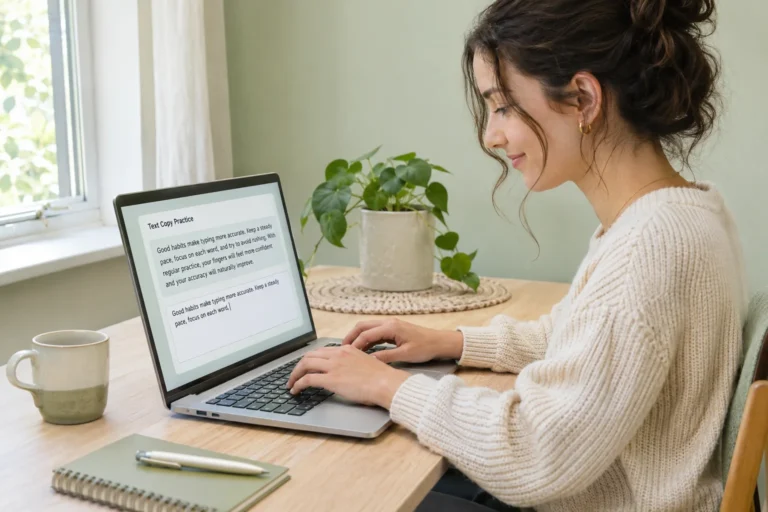
Use paragraph typing practice for the untimed part. Keep your eyes on the text when you can, but slow down if you lose your position.
Do not force speed by pressing harder or moving your hands more.
Keep Accuracy in the Plan
A higher WPM number with many corrections may not help with everyday writing. If errors rise, reduce your pace until you can finish a sentence cleanly, then build speed gradually.
The Aalto University summary of a large typing study explains that mistakes and the time spent correcting them can hold back typing performance.
That supports watching errors alongside speed, rather than treating fast finger movement as the only goal.
Compare Sessions Fairly
Review several attempts made under similar conditions. Notice whether you pause less, correct fewer repeated mistakes, or finish the same kind of text more smoothly.
A single score can change with concentration, reading difficulty, or an unfamiliar keyboard.
If speed keeps rising while accuracy falls, switch your next session to the accuracy improvement guide.
There is no fixed number of days in which everyone should reach a particular WPM.
Common Questions
Should I practice typing every day?
A short routine you can repeat is a useful starting point. Choose a schedule you can maintain, focus on one weakness, and stop when discomfort or fatigue makes the session unhelpful.
Why does my typing speed change between tests?
Duration, text difficulty, familiarity, device, and corrections can change your score. Compare attempts with similar settings and use several results rather than one unusually high or low attempt.